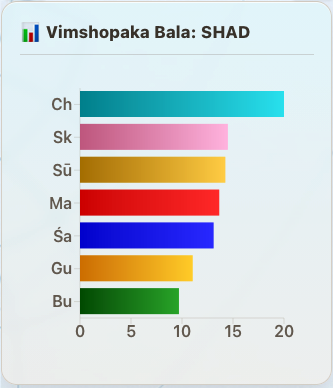
Planetary strength is one of the main analytical layers in Vedic astrology. A Graha does not act only because of its sign or house placement. Its actual capacity to produce results depends on how strong, supported, and active it is within the chart.
Prashna Online evaluates planetary strength through classical strength systems and structured comparison tools. This includes Shadbala, divisional strength, aspect-based influence, and related interpretive metrics.
These strength values are not used in isolation, but as part of a broader chart-reading process. For a structured approach to interpretation, see How to Read a Vedic Astrology Chart.
⸻
Two Grahas may occupy similar positions and still behave very differently.
A strong Graha is more capable of:
A weak Graha may still be important, but it may act inconsistently, produce delayed results, or fail to deliver the support normally expected from its placement.
For this reason, Prashna Online does not treat placement alone as sufficient. Strength is evaluated as a measurable factor.
Understanding strength becomes especially important when working across different chart frameworks such as birth, transit, and horary. For a full overview, see Types of Vedic Astrology Charts (Birth, Transit, and Horary Explained).
⸻
Shadbala is the main classical strength system used in the software. It combines six major categories of planetary strength into a single total.
For each of the seven classical Grahas, Prashna Online calculates:
These classical strength concepts are rooted in traditional Jyotish sources. For the textual background behind these systems, see Classical Sources Behind Prashna Online (Parashara & Jaimini).
These values are first calculated individually and then summed into a final Shadbala total.
Prashna Online stores the total in:
This makes it possible to compare Grahas directly instead of looking only at raw traditional values.
⸻
Sthana Bala measures positional strength. In Prashna Online it is built from the standard internal components:
These together form the total positional strength of the Graha.
This helps answer whether a planet is strong because of dignity, placement, division-based support, or structural position in the chart.
⸻
Dig Bala measures directional strength.
Prashna Online calculates Dig Bala according to the active house system, allowing the result to reflect the currently selected interpretive framework rather than forcing one static value.
This is especially important when comparing house-system-dependent views of the same chart.
⸻
Kala Bala measures time-based strength. In Prashna Online it is broken down into the following parts:
This allows the software to show not only the total, but also the reason a Graha is gaining or losing strength through time conditions, lunar phase, season, daily division, or planetary war correction.
Yuddha Bala is applied after the first total pass, and the total is then recalculated. This means the final Shadbala reflects the corrected post-war value rather than a pre-correction estimate.
⸻
Chesta Bala represents the dynamic strength of a Graha based on its apparent motion.
In Prashna Online, Chesta Bala is calculated using the motion state (Avastha of each Graha, such as:
Each motion state is assigned a numerical strength value.
⸻
Different traditions assign different strength values to these motion states.
Prashna Online supports multiple Chesta Bala classes allowing the user to select which value system is used in the calculation.
This means:
The chosen class directly affects:
This makes it possible to:
⸻
The Sun and Moon are not assigned a standard Chesta Bala value in the final Shadbala total.
Their strength is instead reflected through:
This follows the structural logic of the implemented system and avoids introducing artificial motion-based values where they are not traditionally applied in this framework.
⸻
Chesta Bala primarily influences:
A retrograde Graha, for example, may receive significantly increased strength depending on the selected class.
As a result, Chesta Bala can noticeably shift:
⸻
Naisargika Bala is the natural inherent strength of a Graha.
Unlike the other components, this does not depend on chart placement. It represents the classical natural potency assigned to each planet and is included directly in the total.
This gives the system a stable baseline layer beneath the more dynamic strength categories.
⸻
Drig Bala measures strength derived from aspects.
In Prashna Online, aspectual influence is calculated numerically and then included in the final total as Drig Bala. This allows supportive and harmful influences to affect strength in a measurable way instead of being treated only descriptively.
The result is that planetary interaction is not left outside the strength model; it becomes part of the final evaluation.
Because aspect strength directly affects planetary interaction, it should always be interpreted alongside overall chart structure and terminology. For definitions of key Jyotish terms, see Vedic Astrology Terms Explained.
⸻
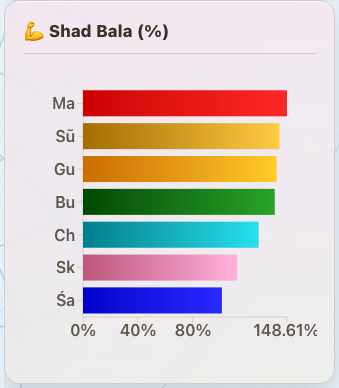
For each Graha, Prashna Online produces:
This percentage is not arbitrary. It is calculated against Graha-specific baseline values, so the final number reflects how strong that planet is relative to its own classical standard, not relative to a universal one-size-fits-all benchmark.
This allows the user to see not only which Graha is strongest in raw numbers, but also which Graha is performing above or below expectation for its own class.
⸻
Prashna Online does not only calculate Shadbala — it presents the results in a structured and interactive way designed for practical chart analysis.
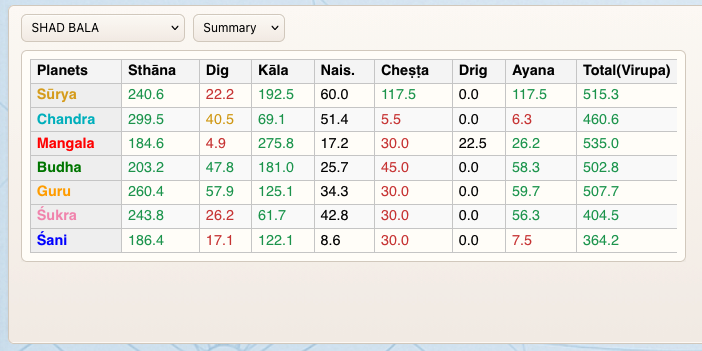
The main Shadbala table displays all Grahas side by side, allowing direct comparison.
For each Graha, the table includes:
The columns can be reordered, allowing the user to prioritize specific strength components depending on the analysis.
⸻
Each major strength component is compared against classical BPHS threshold values.
The result is displayed visually:
This allows immediate visual identification of:
without reading raw numbers.
⸻
Some strength components depend on the selected house system.
In Prashna Online:
This means strength is not displayed as a fixed number, but as a value consistent with the chosen interpretive framework.
⸻
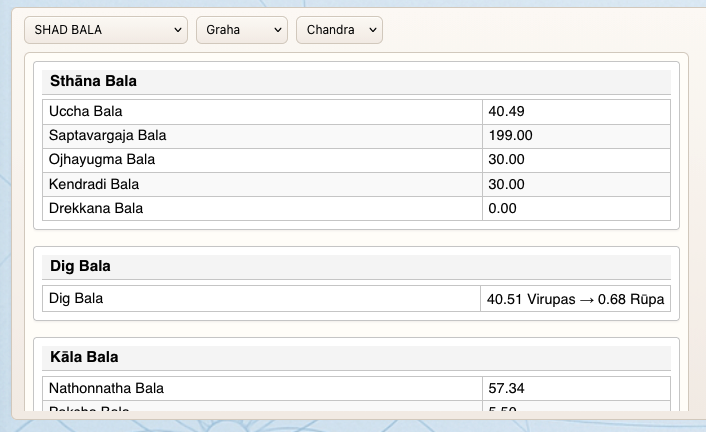
Each Graha can be inspected individually.
The detailed view shows:
This allows precise analysis of *why* a Graha is strong or weak, instead of relying only on totals.
⸻
All values are presented in:
This makes the output usable both for traditional interpretation and for modern comparative analysis.
⸻
Each Graha is evaluated against its own classical baseline.
The percentage value shows:
This prevents misinterpretation where one planet appears strong simply because its raw numbers are higher than another.
⸻
This presentation allows the user to:
The goal is not only to calculate Shadbala, but to make it immediately usable in interpretation.
In the frontend, Prashna Online does not only display raw values. It also compares key Shadbala components against traditional threshold values for each Graha.
These threshold checks are applied to values such as:
The result is shown visually:
This makes the table useful not only for technical reading, but also for fast diagnostic interpretation.
⸻
Some strength values in Prashna Online depend on the currently selected house system.
For example:
This means the software is not simply dumping one frozen result. It reflects the interpretive context currently chosen by the user.
For practitioners comparing Rashi, Equal, or Sripati style views, this matters.
⸻
Strength alone is not the whole interpretation.
A strong Graha is not automatically benefic in outcome, and a weak Graha is not automatically irrelevant. Final judgment still depends on:
But strength remains essential because it helps answer a prior question:
Can this Graha actually act with force?
Prashna Online treats this as a measurable problem, not just a verbal impression.
⸻
Vimshopaka Bala evaluates how well a Graha is supported across divisional charts.
Instead of judging strength only from the main birth chart, it measures how consistently a planet holds dignity and support across multiple Vargas.
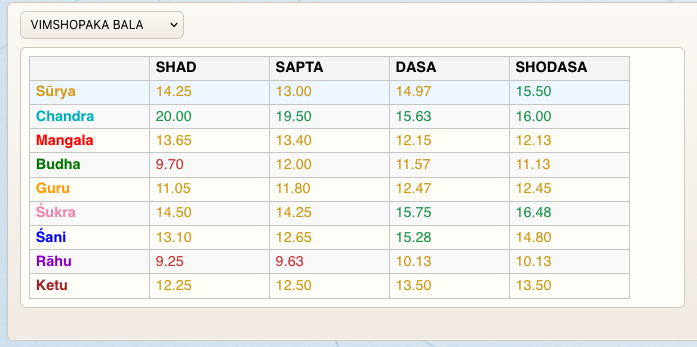
In Prashna Online, Vimshopaka Bala is presented as a comparative table across four classical schemes:
Each scheme uses a different set of divisional charts and therefore provides a different depth of evaluation.
Vimshopaka Bala becomes particularly relevant when refining results within smaller divisions of the chart.
⸻
For each Graha, Prashna Online displays its Vimshopaka value in all four schemes side by side.
This makes it possible to see:
The table includes the nine Grahas and allows direct comparison across all schemes in one view.
⸻
Prashna Online does not present Vimshopaka Bala as raw numbers only.
Each value is color-coded for faster interpretation:
This allows the user to identify strong and weak Grahas immediately without manually scanning every number.
⸻
The Vimshopaka display is especially useful when:
A Graha that appears strong in the main chart but weak across multiple Varga schemes may not be as reliable as its basic placement suggests.
Conversely, a Graha with stable Vimshopaka support across schemes may deserve greater interpretive weight.
⸻
In Prashna Online, Vimshopaka Bala complements Shadbala rather than replacing it.
Together they help distinguish between:
This makes Vimshopaka Bala an important secondary layer in planetary evaluation.
Planetary evaluation in Prashna Online is not limited to Shadbala.
The software also supports:
These layers do not replace Shadbala. They complement it.
Together they allow the user to distinguish between:
⸻
With these strength systems, Prashna Online can help the user:
This is especially useful when multiple Grahas compete for interpretive importance, or when a chart contains mixed signals that need to be ranked rather than merely described.
⸻
Planetary strength in Prashna Online is not treated as a decorative number. It is a central analytical layer.
The software calculates and displays:
This makes it possible to evaluate not only where a Graha is placed, but how effectively it can act.
⸻
⸻
Previous: How to Read a Vedic Astrology Chart (Step-by-Step Guide)
Next: Kakshas in Vedic Astrology (Ashtakavarga Subdivisions Explained).