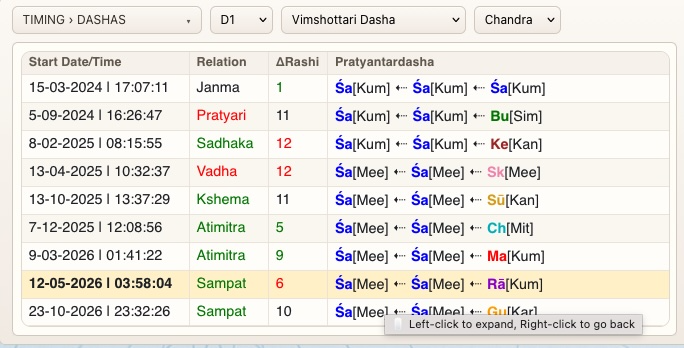
Jyotish Dasha systems are planetary timing methods used in Vedic astrology to understand when specific Grahas become active and how their influence unfolds through time. Prashna Online calculates and displays Dasha periods as an interactive timing tree for structured Jyotish analysis.
Instead of showing only static chart placements, Dasha timing analysis helps the practitioner examine planetary periods, sub-periods, Nakshatra relations, Graha distance, divisional chart context, and transit-supported timing layers.
In Prashna Online, Dashas are treated as a structured timing layer. They are calculated, displayed, expanded, and inspected in a way that supports practitioner-led interpretation.
⸻
A Dasha is a planetary period. Each period is ruled by a Graha, and each Graha activates themes connected with its position, dignity, house relevance, Nakshatra connection, dispositor relationships, and other chart factors.
Dashas are usually read in levels:
* Mahadasha — the main planetary period
* Antardasha — the sub-period inside the Mahadasha
* Pratyantardasha — the next subdivision
* Sookshma Dasha — the finer subdivision inside the Pratyantardasha
* Prana Dasha — the deepest practical subdivision used for very fine timing analysis
This layered structure allows the practitioner to move from a broad period to a more specific timing window.
For example, a Mahadasha may describe a major life phase, while deeper sub-periods can narrow the timing and show which Grahas are participating more directly in a specific interval.
⸻
Prashna Online calculates Dashas from the selected chart context, selected Graha, selected divisional chart, and selected Dasha system.
The calculation is based on the required astronomical and chart data already available in the chart context, including planetary positions, Nakshatra information, and the relevant starting point for the selected Dasha system.
The application calculates:
* The active Dasha sequence
* Start and end dates of each period
* Duration of each period
* Multi-level sub-periods
* Planetary sequence according to the selected Dasha system
* Nakshatra-based relationships
* Graha and Rashi distance information
* Contextual chart information needed for interpretation
For birth-based Dashas, the calculation is tied to the birth context. The initial Dasha balance is derived from the relevant Nakshatra position and the rules of the selected Dasha system.
Dasha periods are calculated from the chart data and the selected Dasha rules. Start and end dates are displayed so that the timing sequence can be inspected clearly.
When deeper levels are opened, sub-periods are recalculated from the parent period rather than guessed from a static display. This keeps the hierarchy consistent across Mahadasha, Antardasha, Pratyantardasha, and deeper levels.
When sub-periods are expanded, Prashna Online calculates the next level dynamically from the selected parent period. This allows the Dasha tree to remain interactive without forcing the entire deep structure to be calculated at once.
Prashna Online allows Dasha inspection by selected Graha and selected divisional chart.
This means the user is not limited to one fixed Dasha view. The Dasha display can be adapted to the analytical focus of the practitioner, for example by inspecting Dasha timing through a specific Graha or through a specific divisional chart.
This is useful because different divisional charts emphasize different areas of life. A Dasha period may be examined not only from the main Rashi chart, but also through the relevant divisional context when deeper analysis is required.
Prashna Online does not show Dashas only as date ranges. It also adds contextual interpretive data.
The Dasha display can include Nakshatra-based relationship information, showing how the active Dasha Graha relates through the Nakshatra framework. These relations help the practitioner evaluate whether a period is supportive, obstructive, unstable, productive, or mixed according to the selected timing logic.
The display can also show Graha or Rashi distance information. This helps identify how far one active factor is from another within the chart structure. Distance is useful because Jyotish interpretation often depends not only on which Grahas are active, but also on how they are positioned relative to each other.
Together, Nakshatra relation and distance information give the Dasha view more interpretive depth than a simple chronological period list.
Prashna Online does not need to display every possible sub-period immediately. Instead, the Dasha tree is expanded interactively.
When the user opens a Dasha level, the application requests the relevant sub-periods from the backend. The backend receives the necessary period information, such as the ruling Graha, start date, duration, level, Dasha system, selected Graha, selected divisional chart, and chart context, and returns the calculated sub-periods.
This approach keeps the interface faster and avoids unnecessary calculation of deeply nested periods that the user may never open.
⸻
Dasha navigation can involve many nested levels and repeated backend requests. To keep the application responsive, temporary frontend state and calculated sub-periods may be cached during the active chart session.
The important distinction is:
If the session times out or the page is reloaded, temporary interface state such as expanded Dasha rows may need to be opened again. The underlying chart and Dasha logic are not changed by this. The same periods can be recalculated from the chart context, selected Graha, selected divisional chart, and selected Dasha system.
This means that timeout does not alter the calculation basis. It only affects temporary navigation state in the interface.
⸻
Dashas are displayed as an expandable tree.
The user starts with the main Dasha level and can open deeper levels step by step. Each expanded row reveals the next subdivision of the selected period.
Navigation is mouse-based:
This allows fast movement through the Dasha hierarchy without losing the structure of the timing sequence.
The Dasha display is designed to make timing analysis easier by showing:
This lets the practitioner move from broad timing to detailed timing without losing the hierarchy of the sequence.
⸻
Prashna Online can also support Dasha inspection with transit-based context.
For expanded Dasha levels, the application can calculate or display relevant Graha positions for the start of the selected period. This helps the practitioner compare the Dasha sequence with the planetary condition at that time.
This does not replace classical Dasha interpretation. It adds another inspection layer so that timing, chart structure, and transit context can be studied together.
⸻
Prashna Online currently supports the following Dasha systems:
* Vimshottari Dasha
* Ashtottari Dasha
* Tribhagi 40 Dasha
* Tribhagi 80 Dasha
* Shodashottari Dasha
* Dwadashottari Dasha
* Panchottari Dasha
* Shatabdika Dasha
* Chaturashiti Sama Dasha
* Dwisaptati Sama Dasha
* Shasthayani Dasha
* Shattrimshat Sama Dasha
Each system has its own sequence, duration structure, and calculation rules. The selected system determines how the periods and sub-periods are generated.
⸻
Dashas are not simple date lists. They are interpretive timing structures. A useful Dasha tool must therefore do more than print planetary periods.
It must show the sequence clearly, preserve the hierarchy, allow deeper inspection, and keep the calculation basis reproducible.
Prashna Online is built around that principle. The Dasha view supports structured timing analysis while leaving interpretation in the hands of the practitioner.
⸻
⸻
Previous: Kakshas in Vedic Astrology